Grip Strength as a Longevity Biomarker: What the Research Shows
A cheap handheld device predicts long-term health outcomes about as well as some expensive panels. Grip strength is not magic — it is a window into whole-body muscle function and neurological integrity.
Educational content — not medical advice. This article is informational only and does not replace personalized care from a qualified healthcare professional. Read our full medical disclaimer.
Among the measurements used in aging research, grip strength is an unlikely standout. It costs almost nothing, takes under two minutes, requires no laboratory, and has appeared in large population studies as a predictor of long-term health outcomes.
The important caveat comes first: squeezing a device harder does not make you live longer. Grip strength is a marker, not a mechanism. Understanding what it actually reflects explains both why it predicts so much and why training your hands in isolation misses the point.
Why a hand measurement predicts so much
Grip strength works as a marker because it is a convenient readout of several systems at once.
- Whole-body muscle. Grip correlates reasonably well with total muscle strength. Someone with strong legs, back and shoulders rarely has weak hands, because the same training and the same tissue quality underlie both.
- Neuromuscular function. Producing maximal force requires the nervous system to recruit motor units efficiently. Declining grip can reflect neurological changes as much as muscular ones.
- Nutritional and inflammatory status. Chronic inflammation, undernutrition and chronic disease all erode muscle function, and grip is sensitive enough to register that erosion relatively early.
- Accumulated activity history. Strength reflects years of physical behavior rather than the last month, which makes it more stable than measures that fluctuate day to day.
- Frailty and sarcopenia. Low grip strength is one of the standard components of clinical sarcopenia and frailty definitions, which is why it appears in geriatric assessment protocols.
In other words, grip is a compact summary of how well the musculoskeletal and nervous systems are holding up. That is a lot of information from one squeeze.
What the research actually shows
Large prospective cohort studies across multiple countries have consistently reported that lower grip strength is associated with higher all-cause mortality, higher cardiovascular mortality, greater risk of disability, longer hospital stays, poorer surgical recovery and increased fall risk in older adults. In several analyses, grip strength tracked with outcomes at least as closely as some conventional clinical measures.
Three points of interpretation matter.
First, these are associations, not demonstrated causation. Low grip strength does not cause cardiovascular death. It reflects underlying processes — muscle loss, inflammation, inactivity, undiagnosed illness — that drive the outcome. The measurement is a signal from the system, not the lever that moves it.
Second, reverse causation is a real consideration. Some people have weak grip because they are already unwell, sometimes from conditions not yet diagnosed at the time of measurement. Good studies adjust for this; the association generally persists but attenuates.
Third, the trajectory carries more information than any single reading. A stable or improving grip over several years is more reassuring than one good measurement, and a declining trend is more concerning than a single low value — particularly if it falls faster than expected for your age.
Measuring it properly
Comparability depends on protocol. A number taken casually with an unfamiliar device tells you little.
Standard approach:
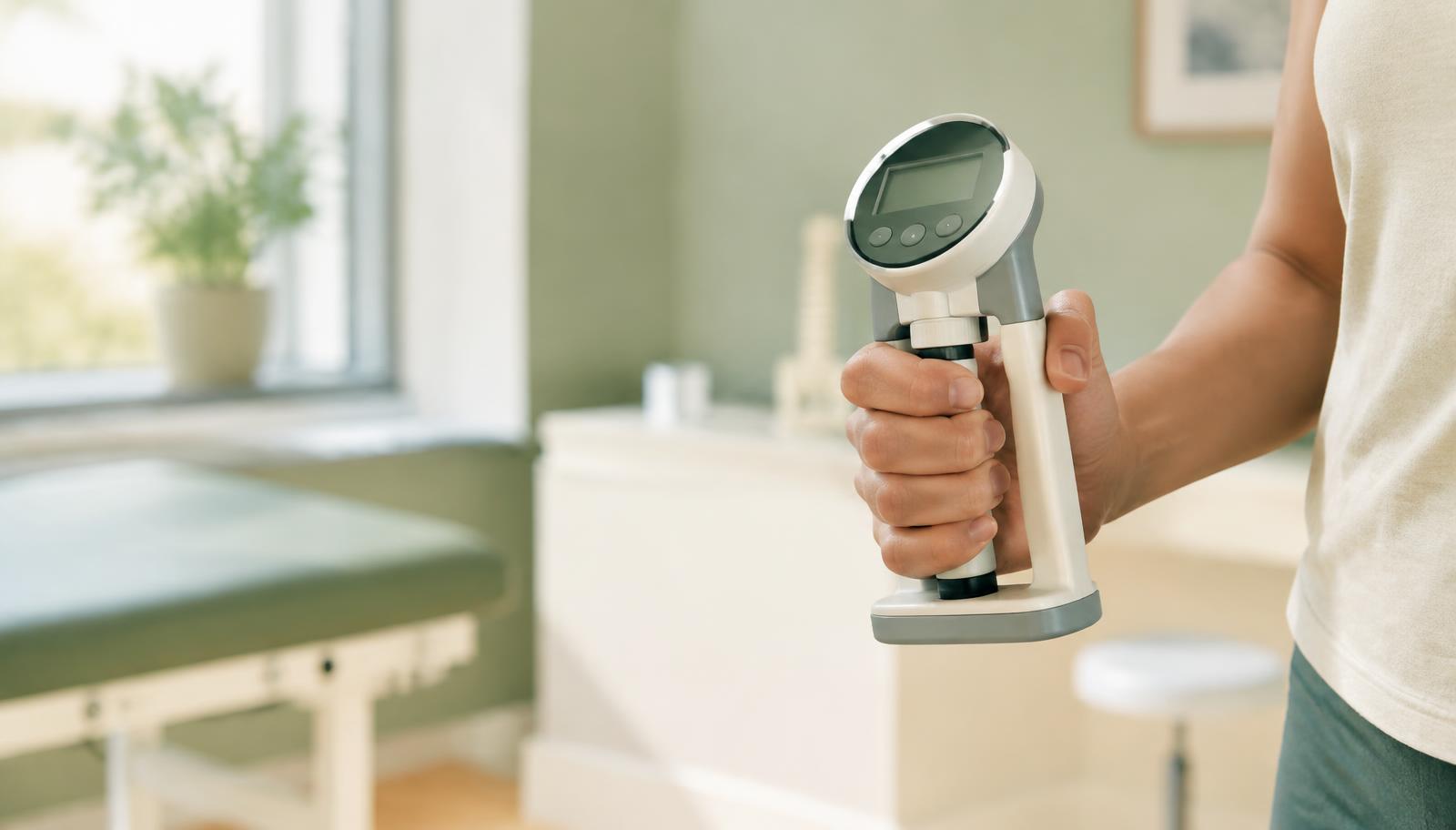
- Use a calibrated hand dynamometer. Hydraulic models are the research standard; reasonable digital consumer devices exist, but do not compare readings across different devices.
- Sit with feet flat, shoulder relaxed and adducted, elbow bent at about 90 degrees, forearm neutral and wrist slightly extended.
- Adjust the handle so the middle joints of the fingers sit comfortably around the grip. Handle position changes the reading substantially.
- Squeeze maximally for three to five seconds, with encouragement. Momentum and body movement do not count.
- Take three attempts per hand with rest between, and record the best value, noting which hand is dominant.
- Repeat under consistent conditions — same device, similar time of day, not immediately after training or heavy manual work.
Measuring every three to six months is enough. The trend is what you are tracking.
Interpreting your number
Reference values vary by sex, age, population and device, which is why a single universal threshold does not exist and any specific figure should be treated as approximate rather than diagnostic.
The general pattern in published reference data:
- Men typically record substantially higher absolute values than women across all ages, so comparisons must be sex-specific.
- Values tend to peak somewhere in the twenties to thirties and decline gradually thereafter, with the decline steepening after about the sixth decade.
- Clinical sarcopenia definitions place cutoffs in the region of the low twenties of kilograms for men and the mid-to-high teens for women, though the exact figures differ between consensus groups and populations.
- A large asymmetry between hands beyond the usual modest dominant-hand advantage is worth mentioning to a clinician.
Rather than fixating on a threshold, ask three questions: Is my value roughly in the expected range for my age and sex? Is it stable or declining across repeated measurements? Does it match my other functional measures? A grip result well below expectation, a rapid decline, or sudden unilateral weakness are all reasons to seek clinical assessment rather than simply train harder.
Improving it
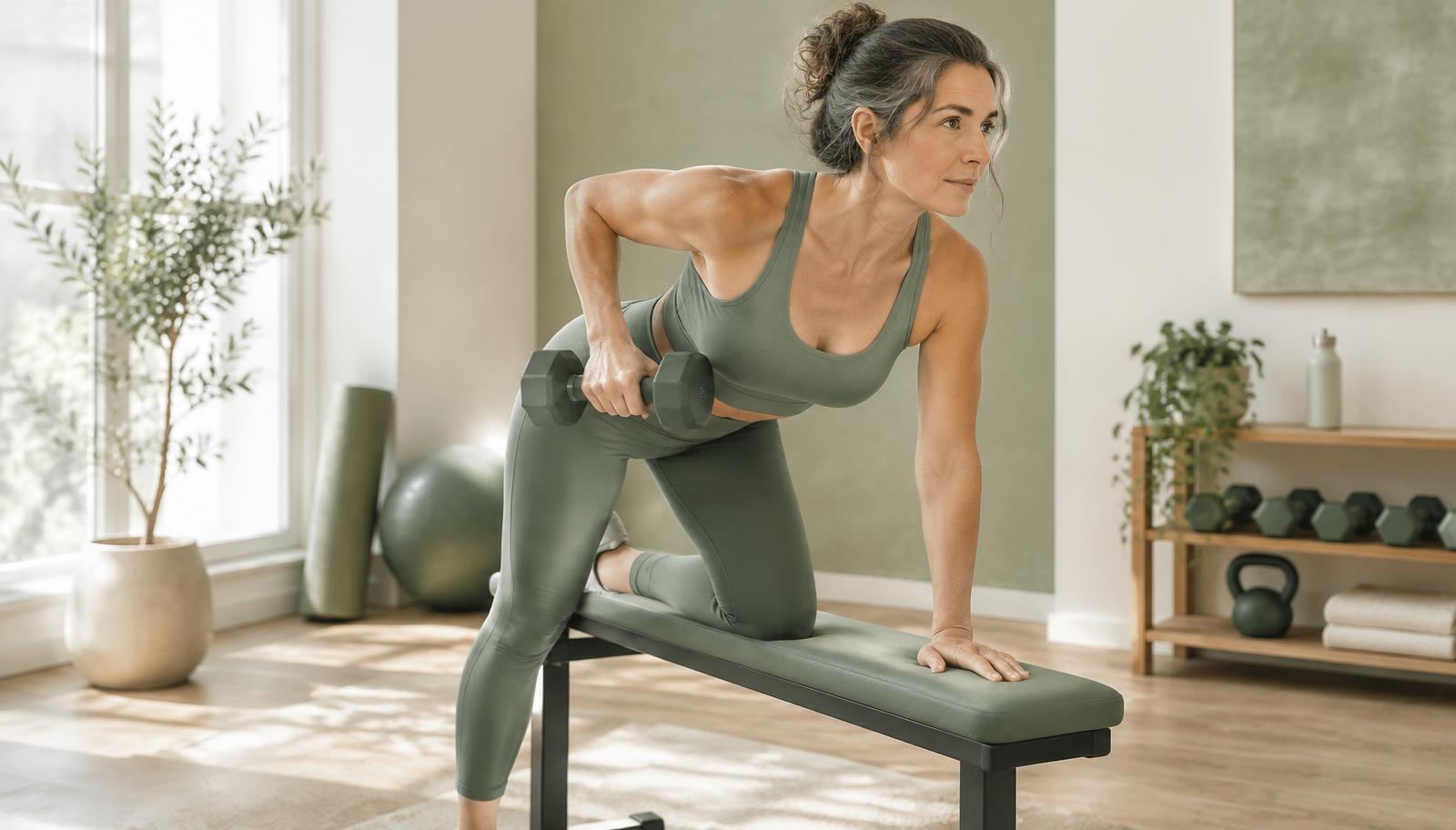
Because grip reflects overall muscular condition, the most effective way to improve it is to train the whole body rather than the hands alone.
- Compound resistance training is the foundation. Deadlifts, rows, pull-ups and presses load the grip heavily while building the systemic strength that grip is actually measuring. Our guide to strength training after 50 covers safe programming.
- Loaded carries are the single most direct transfer exercise. Farmer's walks with heavy dumbbells or kettlebells train grip endurance and full-body stability simultaneously.
- Reduce strap dependence. Straps are useful for maximal pulling, but performing most working sets without them keeps the grip loaded.
- Add direct work if there is a specific deficit. Dead hangs, plate pinches and towel-grip rows can help, though they are a supplement, not a substitute for systemic training.
- Ensure adequate protein. Training provides the signal; protein provides the material. Our article on protein intake and aging covers requirements, which rise in older adults.
- Be patient and consistent. Untrained people often see measurable improvement within eight to twelve weeks of consistent resistance training. Gains slow after that, and in older adults maintaining a stable value against the expected age-related decline is itself a good outcome.
People with arthritis, tendinopathy or nerve compression should get individualized guidance before loading the grip aggressively, since pain-limited weakness needs a different approach than deconditioning.
Where it fits in a longevity assessment
Grip strength is most useful as part of a small panel of functional measures rather than in isolation. Alongside it:
- VO2 max, which reflects cardiorespiratory capacity and is among the strongest functional predictors studied — covered in our article on VO2 max and longevity.
- Gait speed, a simple and well-validated marker of functional status in older adults.
- Sit-to-stand performance, which reflects lower-body strength and power — arguably more relevant to daily independence than grip.
- Balance testing, such as single-leg stance time, which relates to fall risk.
- Body composition, particularly lean mass trajectory over time.
Together these describe functional capacity, which is what most people actually mean when they talk about healthspan. Blood panels and epigenetic markers describe internal state; functional measures describe what your body can do. Our longevity framework uses both, because tracking capacity over years gives a clearer picture than any single test at one moment.
The practical takeaway is modest and useful: measure it, track the trend, train the whole body, and treat an unexpected decline as information worth discussing with a clinician rather than a verdict.
This article is educational and does not constitute medical advice. Persistent or sudden weakness should be evaluated by a qualified professional.