Fisetin and Quercetin as Senolytics: Do Natural Compounds Clear Zombie Cells?
Two plant flavonoids sold as supplements are being studied as senolytics. The preclinical biology is genuinely interesting; the human evidence is early, the doses are far above dietary intake, and the marketing has run well ahead of both.
Educational content — not medical advice. This article is informational only and does not replace personalized care from a qualified healthcare professional. Read our full medical disclaimer.
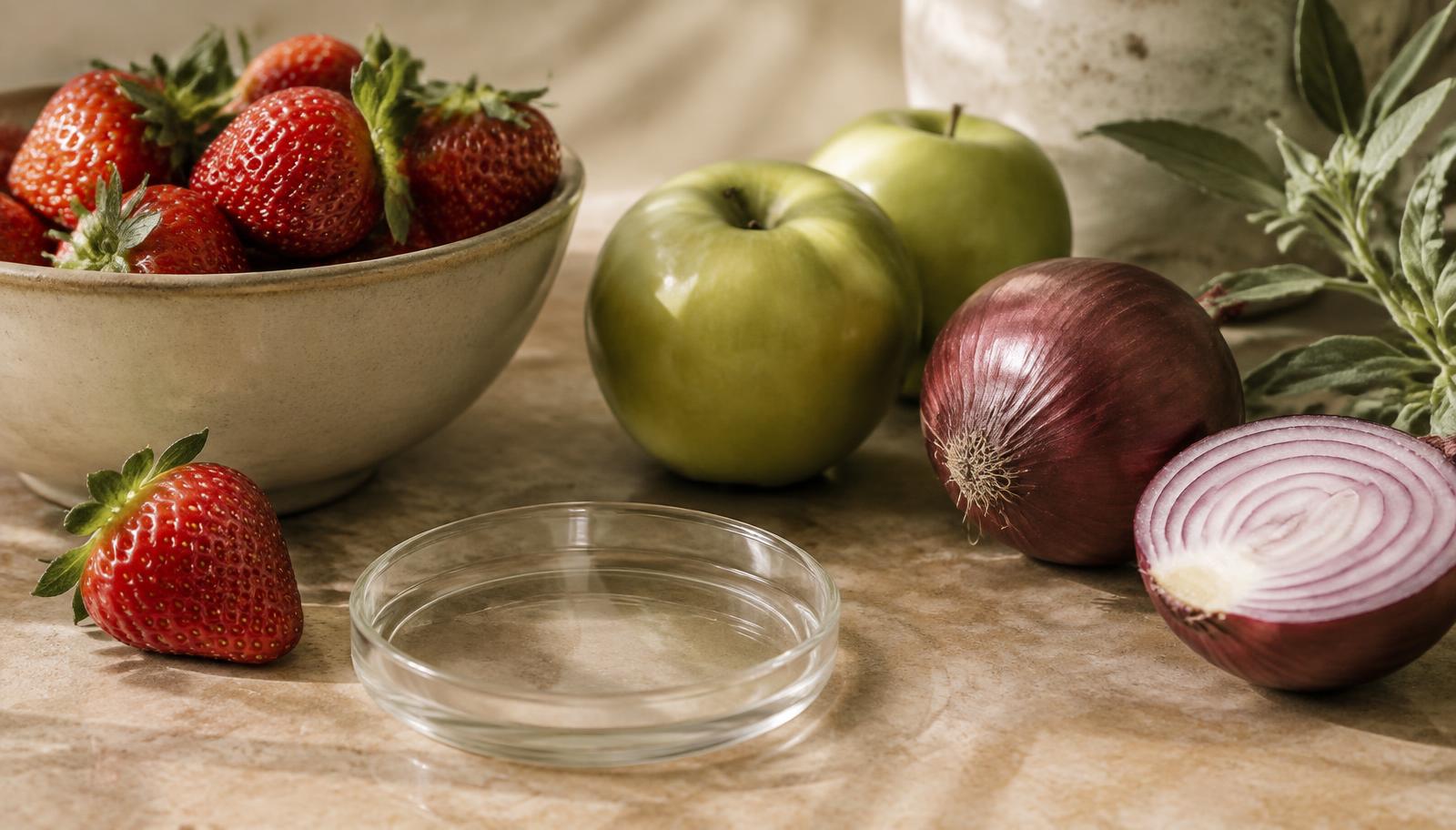
Fisetin and quercetin are flavonoids — plant compounds found in strawberries, apples, onions, capers and other foods. Over the last several years they have been repackaged as "natural senolytics," supplements that supposedly clear the aged cells responsible for much of what we experience as aging.
The underlying science is real and worth understanding. The claims attached to the supplements are considerably further ahead of that science than the labels suggest. This article separates the two.
What senescent cells are and why they matter
When a cell experiences enough damage — DNA damage, oxidative stress, telomere shortening, oncogenic signaling — it has three broad options: repair, die by apoptosis, or enter senescence. A senescent cell stops dividing permanently but does not die. It sits in the tissue, metabolically active, resistant to the normal apoptotic signals that would clear it.
This is protective in the short term. A damaged cell that cannot divide cannot become a tumor, and senescence plays a constructive role in wound healing and development.
The problem is accumulation. Young immune systems clear senescent cells reasonably efficiently. With age, clearance declines and production increases, so these cells build up in tissue. And they are not inert: they secrete a cocktail of inflammatory cytokines, chemokines, growth factors and proteases known as the senescence-associated secretory phenotype, or SASP. The SASP degrades the surrounding tissue environment and can push neighboring healthy cells into senescence — a local contagion effect.
This is why senescent cells are considered a hallmark of aging and are causally implicated, in animal models, in inflammation, tissue dysfunction and multiple age-related conditions. Our article on senescent cells covers the underlying biology in more depth.
What a senolytic is supposed to do
A senolytic is a compound that selectively kills senescent cells while sparing healthy ones. The selectivity depends on a specific vulnerability: senescent cells survive by upregulating anti-apoptotic pathways — the SCAP networks, including BCL-2 family proteins and PI3K/AKT signaling — that suppress the death signal they would otherwise follow. A senolytic interferes with those survival pathways, and the cell, already primed to die, does.
The proof of concept came from transgenic mouse models in which senescent cells could be eliminated on command. Clearing them was associated with improvements across several tissues and, in some experiments, extended healthy lifespan. That result made senolytics one of the most actively pursued directions in aging biology.
An important implication of the mechanism: because senolytics kill cells rather than occupy a receptor, researchers generally study them as intermittent "hit-and-run" dosing — a few days of treatment, then weeks off — rather than continuous daily use. Senescent cells re-accumulate slowly, so continuous exposure is not obviously necessary and may add risk without adding benefit.
Where fisetin and quercetin come in
Quercetin was among the first compounds identified with senolytic activity, in combination with dasatinib, a prescription kinase inhibitor used in leukemia. In that pairing, dasatinib and quercetin appear to target different subsets of senescent cells, which is why they are studied together rather than separately.
Fisetin was identified subsequently through screening of flavonoids for senolytic activity, and in those screens it stood out as among the more potent of the compounds tested in cell culture. In mouse studies, intermittent high-dose fisetin has been associated with reduced markers of senescence in multiple tissues, reduced inflammatory markers, and in some experiments improved health measures in older animals.
These are genuinely interesting preclinical results. They are also preclinical results, in mice, at doses that do not straightforwardly translate.
What human trials actually show so far
This is where honesty matters most.
- Human senolytic research is early. Published clinical work consists largely of small, open-label or early-phase studies, often in specific disease populations — pulmonary fibrosis, chronic kidney disease, diabetic kidney disease — rather than in healthy adults seeking longevity benefits.
- Most of the human data involves dasatinib plus quercetin, not quercetin alone and not fisetin alone. Findings from that combination cannot be transferred to a supplement containing only the flavonoid.
- Early-phase results have been mixed and preliminary. Some studies report reductions in markers of senescent cell burden in tissue or in circulating SASP factors; others find no clear effect on the clinical outcomes measured. Trial sizes are small, and several ongoing phase 2 trials have not reported.
- No senolytic has demonstrated, in humans, that it slows aging, extends lifespan or reliably improves an age-related clinical outcome. That statement is not controversial among researchers in the field.
- Dosing in trials is far above dietary levels. Study protocols for fisetin have used intermittent doses in the range of 20 mg per kilogram of body weight per day for a few consecutive days — grams per day for an adult, orders of magnitude above what any realistic diet provides. No amount of strawberries reproduces a trial dose.
The gap between "interesting mouse data plus small early human studies" and "clears zombie cells, reverses aging" is the entire distance a supplement label typically omits.
Bioavailability and formulation problems
Both compounds share a practical obstacle: poor oral bioavailability. Quercetin in particular is absorbed inconsistently, extensively metabolized in the gut and liver, and rapidly cleared, meaning plasma concentrations from ordinary supplementation are typically far below what produces senolytic effects in cell culture. Fisetin has similar limitations.
Manufacturers respond with liposomal preparations, phytosome complexes and piperine co-administration to improve absorption. Some of these approaches do measurably increase plasma levels. Whether they increase them into the range required for senolytic activity in human tissue is not established, and enhanced absorption also means enhanced exposure for any off-target effect.
Supplement quality is a separate issue. These are not regulated as drugs in most markets, so actual content, purity and dose accuracy vary between products. Third-party testing is the minimum bar.
Safety and interactions
Both flavonoids are widely consumed in food and are generally well tolerated at supplement doses in short-term use. Reported adverse effects are usually mild: digestive upset, headache, occasional fatigue. Very high or prolonged quercetin dosing has raised occasional concern about kidney effects, and high-dose data in humans is limited.
The more practical concern is interactions. Quercetin inhibits several cytochrome P450 enzymes and drug transporters, which can alter the blood levels of other medications — a genuine issue for anyone taking anticoagulants, certain blood pressure medications, immunosuppressants, some antibiotics, or drugs with a narrow therapeutic window. Flavonoids can also affect thyroid function at high doses in some contexts, and their interaction with chemotherapy is uncertain enough that oncology patients should not self-supplement.
Anyone pregnant, breastfeeding, taking prescription medication, or managing a chronic condition should treat these as pharmacologically active compounds and discuss them with a physician before use, not as innocuous food extracts.
How to think about it
If you find the science compelling, the reasonable position is interest without conviction.
The biology of cellular senescence is one of the better-supported hallmarks of aging, and senolytics are a legitimate and active research direction with real trials underway. It is entirely plausible that effective senolytic protocols will exist. It is also plausible that the compounds that prove effective will be prescription drugs at defined doses, not flavonoid capsules.
What the current evidence supports is modest: these compounds are being studied, the preclinical signal is interesting, human data is early and mixed, and no claim of anti-aging efficacy in humans is established. Anyone considering supplementation should do so with medical guidance, with attention to interactions, and with realistic expectations about what an early-stage research compound can be expected to deliver.
Meanwhile, the interventions with the strongest evidence for influencing senescent cell burden and inflammatory load remain the familiar ones — regular physical activity, adequate sleep, maintaining metabolic health, and a diet rich in whole plant foods. Our articles on autophagy and fasting and polyphenols in food cover adjacent mechanisms, and our broader longevity framework explains how we weigh emerging compounds against established ones.
This article is educational and does not constitute medical advice. Supplements can interact with medications and may be considered only alongside qualified medical guidance.